Why Does Distinction Matters?
In the world of global trade and supply chain management, the terms freight forwarder, courier, and carrier are often used interchangeably, but they refer to very different functions in the value chain. For businesses planning shipments, choosing the right type of service is not just semantics, it affects cost, speed, reliability, and ultimately customer satisfaction.
As a full service logistics provider, IFS Global Logistics sits at the heart of this ecosystem, offering services across all these categories and helping clients match the right type of transport to their needs. This post explains the distinctions.
What is a Freight Forwarder
A freight forwarder is an intermediary, not the company physically moving your goods, but the architect of transport. Freight forwarders coordinate shipments by liaising with multiple carriers including ships, planes, trucks, and rail, selecting routes, consolidating cargo, managing customs and documentation, and often providing warehousing, cargo insurance, and tracking.
This makes them ideal for:
- International shipments, especially cross border trade
- Large volume or complex shipments such as containers, pallets, bulk cargo, or heavy equipment
- Shipments requiring customised solutions such as multi leg routes, special packaging, consolidation from multiple suppliers, warehousing between legs, import or export compliance, and regulatory documentation
Because of this complexity and scope, freight forwarding tends to be more flexible and often more cost efficient per unit for high volume or bulk shipments, although it may require more lead time and coordination compared to courier services.
At IFS, our freight forwarding services underpin many of our offerings including air and ocean freight, road freight across the EU and UK, customs brokerage and compliance, warehousing, and more, creating end to end logistics solutions.
What is a Courier Service
A courier is a business that delivers parcels, packages, or documents, prioritising convenience, and door to door service. Couriers generally operate their own transport networks. This gives them control over the entire shipment journey from pickup through to final delivery, often including customs clearance for international courier services.
Best suited for:
- Small shipments such as packages, parcels, and documents
- Urgent, time sensitive deliveries including prototypes, medical supplies, e commerce parcels, and samples
- Situations where you want a simple, one company solution that includes pickup, customs paperwork for international shipments, and delivery with minimal coordination required
Because of their speed, convenience, and end to end handling, courier services usually carry a premium price per kilogram or per parcel compared to bulk shipping alternatives.
At IFS, our Courier Express offering fits this category and is ideal for clients who need reliable, small parcel delivery, domestically or internationally.
What is a Carrier and How It Differs
A carrier refers to the actual transport operators, the companies or entities that physically move goods using trucks, ships, planes, or trains.
Key points:
- Carriers take possession of the goods, transport them by a suitable mode such as sea, air, road, or rail, preserve them during transit, and deliver them to the destination under a bill of lading or similar contract
- Carriers typically move goods in large volumes over long distances between ports, hubs, warehouses, and distribution centres rather than making last mile deliveries to customers
- Because of the scale and infrastructure involved, carriers are more cost efficient per unit when dealing with large loads or long haul transport, but they are less suited for small parcels or high speed, end customer deliveries
In practice, a freight forwarder will often contract with one or several carriers to transport goods. The forwarder arranges and coordinates the shipment, and the carrier executes the physical transport.
Why Understanding These Roles Matters for Businesses and for IFS Clients
Making the right choice between a courier, a freight forwarder, or a carrier, or combining them, depends on your shipment’s specific requirements. Here is when each makes sense:
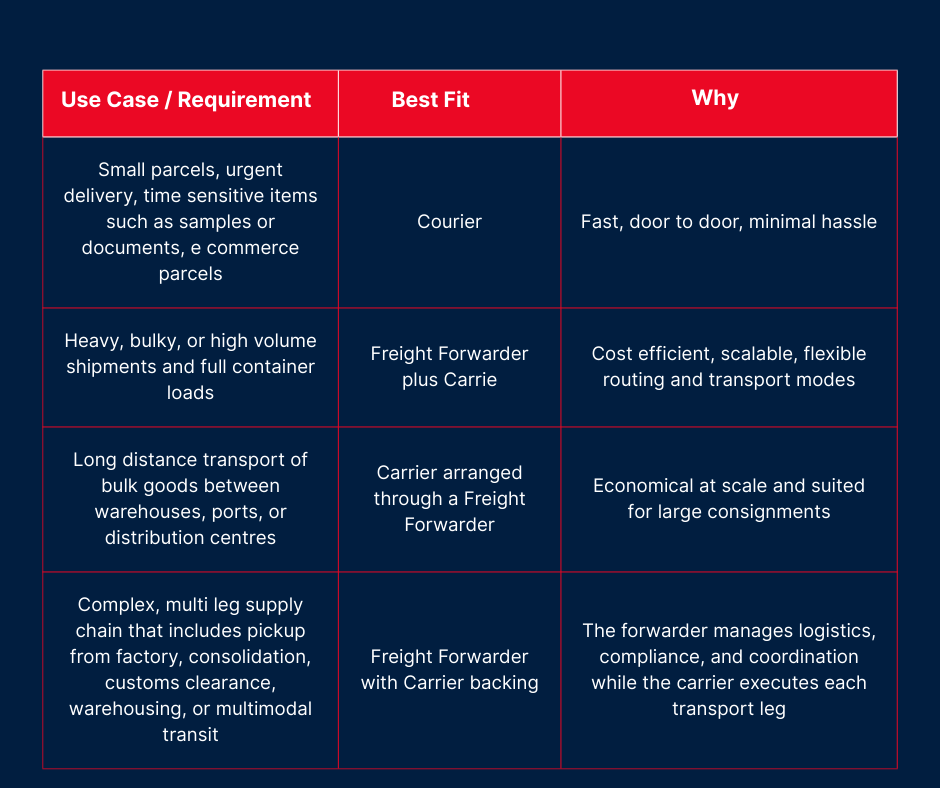
For IFS clients, this means flexibility. Whether you need parcel delivery, bulk import or export shipments, customs clearance, warehousing, or a mix, IFS is structured to handle it all. As a unified provider offering air freight, ocean freight, road freight, courier express, customs brokerage, warehousing, and vendor managed inventory, IFS allows businesses to scale and adapt without juggling multiple providers.
How to Choose, Questions to Ask Before Booking a Shipment
When evaluating shipment options, consider asking:
- What is the size, weight, or volume of the shipment?
Small parcels point to a courier. Large, heavy, or palletised shipments point to freight forwarding with a carrier. - How urgent is the delivery?
For next day or time critical delivery, a courier or air freight solution may be required. For less time sensitive bulk goods, freight forwarding is usually optimal. - Will you require customs, documentation assistance, warehousing, or consolidation?
If yes, a freight forwarder is essential. - Is this part of a larger supply chain process such as inventory replenishment or recurring shipments?
If yes, a freight forwarder provides flexibility, network access, and operational support.
IFS can map your real world shipping profile to the most efficient solution. For example, if your business ships a mix of parcels and pallets regularly, IFS can blend courier express, freight forwarding, warehousing, and road freight to give you an optimised, dependable logistics plan.For businesses operating across Northern Ireland, the UK, and Europe, having a trusted logistics partner who understands every part of the transport and compliance landscape is crucial. IFS Global Logistics is positioned as a full spectrum provider, offering solutions from express courier parcel delivery to complex international freight forwarding, giving clients clarity, confidence, and efficiency throughout the supply chain.